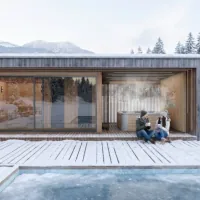
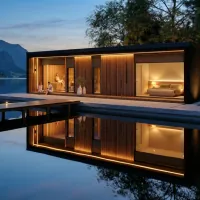
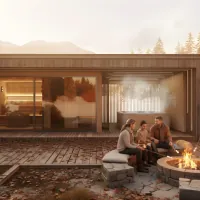
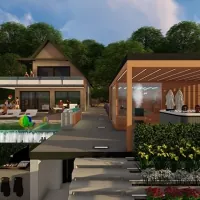
Sauna materal: Yakisugi Ignite panelling
Yakisugi Ignite wood for exterior cladding
Yakisugi Ignite is a specially heat-treated, surface-carbonized wood material that represents the modern, industrially controlled evolution of the traditional Japanese Yakisugi (Shou Sugi Ban) technique. Its primary application is exterior façade cladding, especially in demanding environments such as outdoor sauna houses, wellness buildings, or architectural design elements.
Base materials and wood species:
The technology is originally associated with the use of Cryptomeria japonica, but modern Ignite systems are produced from a variety of wood species. Common base materials include spruce, larch, and pine, as well as thermally modified Thermowood and Canadian red cedar. The selected wood species directly influences the surface structure, the depth of carbonization, and long-term dimensional stability.
Manufacturing process and technology:
During production, the wood surface is treated at high temperatures in a controlled environment, typically between 300-400 °C. As a result, the outer layer of the wood partially carbonizes (approximately the top 1-3 mm), while the internal structure becomes stabilized. After carbonization, the surface is cooled and then brushed or refined to reveal the natural grain and achieve the desired texture.
One of the key advantages of modern technology is the precise control of this process, allowing for more consistent quality and more predictable performance compared to traditional open-flame burning methods.
Properties of Yakisugi Ignite wood:
One of the most important technical benefits of Yakisugi Ignite is its reduced moisture absorption, which can be up to 30-50% lower. The carbonized surface partially seals the wood’s pores, making it less sensitive to changes in humidity. This significantly improves dimensional stability by reducing warping, cracking, and overall material movement. In outdoor environments, where wood is constantly exposed to rain, UV radiation, and temperature fluctuations, this is a critical advantage.
Another benefit of the heat treatment is the increased natural resistance of the wood to biological factors. Fungi, insects, and mold are less able to develop on the carbonized surface, resulting in improved durability without the need for chemical treatments. In addition, the charred layer provides a certain level of fire resistance by slowing down the combustion process.
From a thermal perspective, Yakisugi Ignite also offers favorable properties. The carbonized surface has lower thermal conductivity, contributing to a more balanced surface temperature. This is particularly important in applications such as outdoor sauna houses, where materials are exposed to extreme temperature differences.
Application of Yakisugi Ignite in sauna houses:
The visual appearance of the surface is not merely aesthetic but a direct result of the technology. The deep, charred texture enhances the natural wood grain while creating a more uniform, dark-toned finish. Different processing methods, such as brushing or smoothing, allow for a range of visual styles from rustic to clean, minimalist surfaces.
For installation, Yakisugi Ignite cladding should always be used in a ventilated façade system. Proper ventilation ensures that moisture does not accumulate behind the cladding, significantly extending the lifespan of the structure. It is recommended to use stainless steel fasteners and, where possible, concealed fixing systems to maintain a clean, uninterrupted surface appearance.
In terms of maintenance, this material is particularly advantageous. The carbonized layer provides natural protection, eliminating the need for regular painting or intensive surface treatment. Over time, the surface may develop a slight patina, which is considered a natural aging process rather than a defect. If needed, surface renewal can typically be achieved with simple oil treatment.
With proper installation and structural design, Yakisugi Ignite cladding can achieve a lifespan of several decades. This is especially important in premium outdoor sauna projects, where material selection is not only a visual decision but also a long-term technical investment.